
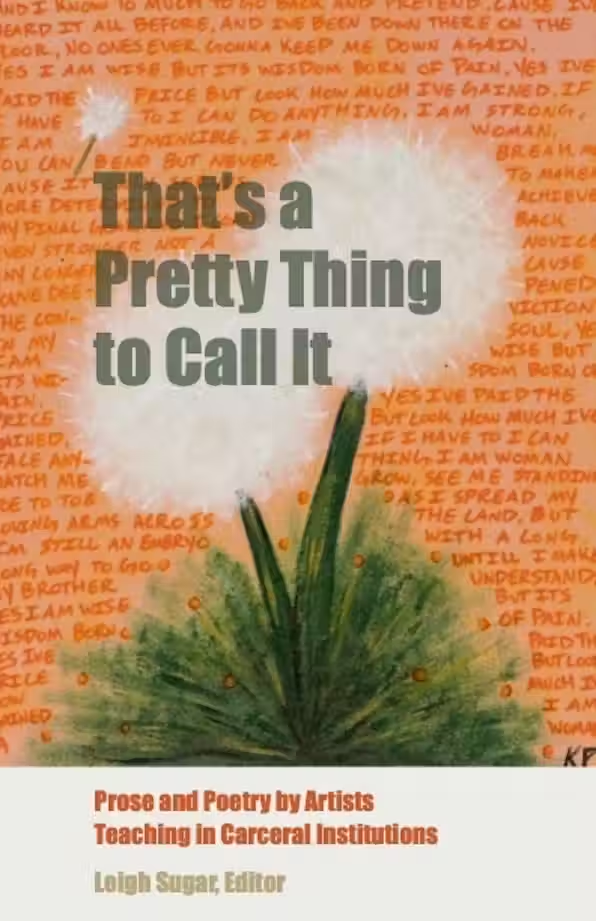
“That’s a Pretty Thing to Call It” Prose and Poetry by Artists Teaching in Carceral Institutions
Review by Cid Galicia
Edited by Leigh Sugar
Published by: New Village Press
October 2023
IBSN: 978-1-61332-211-6
“In a real sense, all life is interrelated. All men are caught in an inescapable network of mutuality, tied in a single garment of destiny. Whatever affects one directly, affects all indirectly. I can never be what I ought to be until you are what you ought to be, and you can never be what you ought to be until I am what I ought to be…This is the inter-related structure of reality.”
-Martin Luther King
Letters From Birmingham Jail
To read Leigh Sugar’s collection of writing, in That’s a Pretty Thing to Call It, is like visiting a prison, looking through the bars, and seeing – perhaps a villainized version of yourself. How is it that when you stop and stare at the person behind bars that you both know and don’t know them? You love them, and are scared of them; You want to save them, help them, or at least listen to them. And in the end decide that the best and most empathetic thing to do is to offer connections and resources with which they can develop their voice and share it by way of publication, with hope that it will lead to positive change in the “justice system.”
This is a collection of writing by artists who have taught creative arts to people who are incarcerated or otherwise involved in the criminal legal system. Contributions were selected from submissions responding to a national call, as well as from targeted outreach to specific individuals involved in the prison arts community. I accepted poetry and prose, fiction and nonfiction. This project is unique in its poly-vocality: it gathers accounts from artists from across the country (and one international submission) working across different mediums, demonstrating the range of experiences one can have when entering these institutions.
Justice System…what a strange and sad term. One of the first thoughts in my head was how would someone go about trying to design and manifest such a potentially treacherous literary task – given the current state of the relationship between citizens and law enforcement. And even if you were able to – how would you manage to gather allies and not offend both the people whose voices you are trying to help broadcast – as well as those who fund, lead, staff, and work to keep them contained? In an interview with New York University she was asked, and addressed those thoughts and struggles openly and honestly:
I was nervous about how and where to position this writing
given that I didn’t want to speak for incarcerated artists or
co-opt the conversation. So, I realized I couldn’t be alone in
these thoughts and started reaching out to others. I soon had enough material to envision a larger collection, and the project has grown over the years through my own professional development to take on a decidedly more political stance.
As an educator in New Orleans, I know that the school-to-prison pipeline is an issue that has been “officially” pushed toward public awareness since 2005. I have deep respect for Sugar’s drive and persistence to push this collection into the present world. How do you best build opportunity, without the reflex to save? It is good that some have helped pave the path for such an undertaking.. Two years ago my MFA mentor Kate Gale, Publisher of Red Hen Press, assigned me to read and digest C. D. Wright’s One Big Self, where she laid witness to hard times in Louisiana Prisons.
Not to idealize, not to judge, not to exonerate, not to
aestheticize immeasurable levels of pain. Not to
demonize, not anathematize. What I wanted was to
unequivocally lay out the real feel of hard time.
-C.D. Wright
Sugar immediately begins to tackle, and address, the difficulty of the lexicon used when discussing the prison setting: The landscape of “hard time” is commonly represented through data. How most information is hidden from the greater population at large, and that which isn’t is geared for the receivers to see inmates/prisoners as dehumanized others. There are nearly two million people jailed in the United States, and this a greatly reduced number in the aftermath of covid. When taking into consideration parole, probation, and other alternative avenues– the real numeric data is closer to six million. The real truth is that the US incarcerates more of its people per capita than any other country in the world.
When asked the why, the reason, and the purpose for this collection–Sugar spoke on the literary community truth that should bother us all, and push us to engage in the power of poly-vocality for change: privilege and accessibility in the arts for marginalized communities.
This book is for non-incarcerated students learning about arts in prison, practitioners looking to share their skills and knowledge with incarcerated students, people concerned with questions surrounding access and privilege in the arts, incarcerated artists interested in the experience of those who enter the facilities to teach, and anybody curious to encounter the prison industrial complex from a human/creative, rather than policy/statistical, perspective.
The collection is divided into three sections: Prose, Hybrid, and Poetry. Let’s walk the prison halls and walls in this collection together, as I offer an observation of what you will encounter should you choose to fully complete the journey on your own.
Prose and Con(s)victs: To Indite or Indict, that is the question.
The prose section opens with Phil Christman’s piece, On Diction and Disprivilege: How an obscure verb changed the ways I edit prisoner’s writing. Christman is an editor for The Sky is On Fire After All: The Michigan Review of Prisoner Creative Writing Volume Six. He was editing Benjamin Cloud’s poem Prison Letters, which you can find on page 172 of Sugar’s collection, specifically the line: Pen meets paper the correspondence indited.
Indited is a transitive verb from the Old French endtier which means to put into words, to compose, or to put into writing. Cloud was right, and Christman found himself wrong. I encourage you to read this piece as he walks you through his inner turmoil of battling himself, his copyeditor/wife, and his typesetter/printer in order to remain true to the writer.
Our society’s collective unwillingness to imagine that such people (intelligent and well-spoken inmates) exist creates an atmosphere in which, even if I believe Benjamin Cloud meant to write “indite,” I’m still tempted to foist an unnecessary and absurd edit on the poem, simply because I don’t think some of his readers will be able to read the word without assuming it’s an error, one ultimately attributable to him, a man in prison, a black man – a man who hardly needs more strangers attributing errors to him. I find myself tempted to butcher his copy for his own protection! Ultimately, of course, I didn’t do so. I didn’t do so because it would be a horrible violation of my role as editor and his role as writer.
Those with privilege often have the instinct to save, correct, or override the action – and in this case the words of those without privilege. Sugar wrestled with this, as did Christman here, as do many others in this collection, and as do I. This collection of growth-oriented people, like those just mentioned, sharing their experiences and actions in contending with this marginalized group of our writing community, should push us to check ourselves to do the same – and to take action on it.
Hybridization Breakouts Come in Threes
Deep in the Hybrid Section of the collection, there is an interview of incarcerated writers selection titled: On Why “Prison Writer” is a Limited Label: What Incarcerated Writers Want the Literary Community to Understand. The stigma the prison writing community finds itself being constantly vetted by is as follows…
On the flip side, nearly every serious writer in prison I’ve encountered grows a similar disdain for, or at least frustration with, the label prison writer – one that slaps on a special qualifier of romanced danger and warped intrigue, invites immediate background checks, sets up expectations of particular content, and potentially turns off an entire readership.
Incarcerated writer Elizabeth Hayes agrees stating:
Every time a prisoner submits their writing into the public sphere they are subjecting themselves to an audience who can easily look them up and be told a prosecutor’s version of a story (true or untrue) about their conviction. This is in juxtaposition to all a prisoner desires: To put the past behind them; To lay low and quietly merge back into society; To reconnect with those they love in fresh circumstances. . . . While all artists/writers question the value of their work and wonder who is viewing it and how it is being perceived, a prisoner who is an artist or who writes always carries the added burden of having to apologize for their past.
In the early 2020s Pen America launched The Breakout Movement: Works of Justice.
This was to become an online series featuring writers and writing connected to the Pen America Prison and Justice Writing Program. The partnership aimed to dig into the relationship between writing and incarceration, and presented challenging conversations about criminal justice in the United States.
In the piece three questions are asked of the incarcerated writers:
- What do you want us to know about the experience of being a writer in prison? Or being a writer outside of prison (the label, the stigma, the space)? Or both!
- What are your hopes for how your work is received by the literary community on the outside?
- In what ways can you envision a lasting connection with the literary community outside the walls? From your perspective, what can we do to be more inclusive, or to help shift the narrative?
Here is one response to the first question by Zeke Caligiuri:
The story of incarceration is not a singular one. Just as the story of marginalization or the dynamics of power do not follow a singular linear moral pathway throughout our history. That is why it is important to broaden the spectrum of voices being held in the great captivity business. Whether free or encaged, we all live with some kind of stigma – that’s the nature of making decisions you can’t take back. We have to temper our own regret with our belief that our work matters at some deeply philosophical or social level, that cannot be represented by anybody else. So, as writers, we are conscientious that a sense of self-value can only be created personally. If we are looking to be redeemed at some greater social level with our work, I’d say that is an undue expectation for our art. We only get short windows of time on this earth to be and create, wasting it because we want other people to love or like, or forgive us is a lot of pressure to put on our art.
Prison Poetry Blues
“On Blueness” by Joshua Bennett appears in the poetry section of the collection. Here is the opening section of the piece.
On Blueness
which is neither misery
nor melancholy per se,
but the way anything buried
aspires. How blackness becomes
a bladed pendulum swaying between
am I not a man & a brother
& meat. How it dips
into the position
of the unthought,
then out. Trust me.
Foucault isn’t
helpful here. I am after
what comes when the law leaves
a dream gutted. The space
between a plea & please.
Bennet has become one of the most powerful emerging voices in contemporary poetry. The Sobbing School, his opening debut in 2014 and winner of the 2015 National Poetry Series Award was born out of state violence against black lives. This piece and many others in this collection force the question: What comes when the law leaves a dream gutted?
This collection is a brave and bold task of shining a light on the prison system in this country, the voices contained therein, and the allies to those voices who would broadcast the idea that their lives and voices hold value and should be heard. This is no minor or easy scripted task. Sugar, her collected writers, and their collected voices however are strong steps in the direction of placing these truths on the pens and papers of us all.
Leigh (she/her) is a writer, teacher, and, most importantly, learner. Her debut poetry collection, FREELAND, is forthcoming from Alice James Books in 2025, and she created and edited That’s a Pretty Thing to Call It: Prose and poetry by artists teaching in carceral settings (New Village Press, 2023). Her work appears in POETRY, jubilat, Split this Rock, and more. She teaches poetry workshops through various organizations including Poetry Foundation, Tupelo Press, Justice Arts Coalition, etc. She co-facilitates (with Nila Narain) Access Oriented Lit, a reading series by and for disabled poets. She also works for Commonplace, Rachel Zucker’s poetry podcast.

That’s a Pretty Thing to Call It is available from NYU Press.