Categories
book review

Cid Galicia Reviews “RAZZLE DAZZLE” by Major Jackson

Navigating Major Jackson’s poetry collection, RAZZLE DAZZLE, is like reading A Jedi’s diary reflecting on experiences and emotions across the galaxy.

Review by Cid Galicia

“RAZZLE DAZZLE”
W. W. Norton & Company Publication September 2023
288 pages
IBSN 10: 1324064900
IBSN 13: 978-1324064909

Luminous beings are we, not this crude matter.

–– Jedi Master Yoda

I still consider myself an apprentice of the art.

–– Major Jackson

What happens when you encounter strong universal forces: infinity, eternity, the dark cloaked one, oracles, narcotic dreams, devils in choirs of fire, natural elements, and love? You may ask to Let Me Begin Again. You may feel the need to skewer all your prayers and slow-roast them in the open air. You may find yourself hearing The Sound We Distress For, and find yourself Thinking in Swedish or Speaking The Language of the Moon. In all cases, the journey through Major Jackson’s poetry collection, RAZZLE DAZZLE, is like reading A Jedi’s diary reflecting on experiences and emotions across the galaxy.

In this collection, your mind will transform into a syntactically radical, time-travelable starship. You will start in the present with the first stop being a newly developed cluster of poems titled: Lovesick. Following that, you will return to the year 2002 with poems from Leaving Saturn. Then you’ll jump forward to 2006 with poems from Hoops, 2010 with poems from Holding Company, and 2015 with poems from Roll Deep. The final destination on this journey that encompasses over 20 years of poetry is a selection of poems from Absurd Man, released in 2020. 

Each section of this collection is worthy of reading again and again; however, this review will focus mainly on the new work in Lovesick and Urban Renewals. 

One of the most compelling qualities in these poems is the grace, smoothness, and emotional depth of the language. Jackson’s diction is magical throughout. The following are a few of the recurring elements and images: Prophet, Infinity, Dark-Cloaked One, Prayers, Eternity, Salvation, Orpheus, Believers, Oracle, Fountain, Mercury, Narcotic-Dream, Church, Infinite-Light, Faith, Fire, Devils, and Reverence. Almost every poem is brimming with mystic and metaphysical language. 

In each, someone, or something, is reaching in search of the sacred. The human experience captured in these moments is often heavy, mundane, and focused on suffering. The additional verses in Urban Renewals is especially honest about the imbalance and poverty in our nation. All of these poems elevate the “everyday” to a plane of cosmic significance. 

In many cultures, text is often a conduit into the something else, something deeper, if we can just alter the lens that we look through. Here Jackson offers language to help us bridge the gap into this place through the experiences of his past. He is a Poetic Jedi Master guiding us—his apprentice readers—to a deeper connection with ourselves and each other.

The words infinity and church appear more than once in these poems, not as a specific archetypal focus on Western culture, but on the universal ancestral connection language offers. It connects the reader to their expansive potential. 

In a few poems, Orpheus and Mercury also make appearances in ancestral tones, exploring the terrains of life and death. The speaker guides the reader into the depths, and by the end, both re-emerge bathed, cleansed perhaps, through song and experience. 

Having lived in New Orleans, Jackson understands the power of the lyrical and rhythmic in the living force and he acknowledges his plight as a “seeker” in the poem The French Quarter.

Over powdered beignets
over demitasse chicory
near Royal, I came to grips I am the lonely sort,
for I am ever seeking…

Of course, a noteworthy aspect of this collection, and all of Jackson’s books, is his ongoing work titled Urban Renewal. Rather than a single standalone poem, Urban Renewal is a sprawling sequence of numbered poems that Jackson has added to throughout his career. Acting as a recurring narrative and stylistic thread, it includes elements of study, observation, protest, and sometimes serves as a call to arms against the Galactic Empire. 

As a poetic providence, it is an echo of rebellion across the universe and “the ethical obligation we have to the communities we claim.”

In closing, whatever route you take as you navigate the poems in this stellar collection, you’ll discover places, experiences, and states of rebirth in a Galaxy [not so] Far Far Away…

May the [poetic] force be with you.


Major Jackson is the author of six books of poetry, including Razzle Dazzle: New & Selected Poems (2023). His edited volumes include: Best American Poetry 2019, Renga for Obama, and Library of America’s Countee Cullen: Collected Poems. A recipient of fellowships from the Academy of American Poets, Fine Arts Work Center in Provincetown, John S. Guggenheim Foundation, National Endowment for the Arts, and the Radcliffe Institute for Advanced Study at Harvard University, Major Jackson has been awarded a Pushcart Prize. He has published poems and essays in American Poetry Review, The New Yorker, Orion Magazine, Paris Review, Ploughshares, Poetry, Poetry London, and World Literature Today. Major Jackson lives in Nashville, Tennessee, where he is the Gertrude Conaway Vanderbilt Chair in the Humanities at Vanderbilt University. He is an elected member of the American Academy of Arts and Sciences and serves as the Poetry Editor of The Harvard Review.    

You can follow him on Instagram @poetmajorjackson

An artistic illustration of a bee in warm orange tones against a black circular background, symbolizing creativity and nature.

RAZZLE DAZZLE is available from W.W. Norton.

Categories
book review

Cid Galicia Reviews “All the Possible Bodies” by Iain Haley Pollock

Iain Haley Pollock’s Poetry Collection “All the Possible Bodies” is a Existential Exploration In a society where identity is pre-ordained

Review by Cid Galicia

“ALL THE POSSIBLE BODIES “
Alice James Books
September 2025
ISBN:
9781949944907

Book cover of 'All The Possible Bodies' by Iain Haley Pollock, featuring a sculpted hand in the foreground, with the title and author's name prominently displayed.

The Matrix is a system, Neo, and that system is our enemy. Unfortunately, no one can be told what The Matrix is. You have to see it for yourself

–-Morpheus (The Matrix)

Everyone keeps trying to tell me how my stories supposed to go. Nah…Ima do my own thing.

–-Miles Morales (Across The Spider-Verse)

Navigating Pollock’s collection, ALL THE POSSIBLE BODIES, is a literary collision of The Matrix and The Spider-Verse. Like Morpheus trying to explain dual realities to Neo and Jefferson Davis (Dad) trying to guide Miles Morales (Spider-Man) through the internal war of becoming a hero, in a world that sees you as the enemy.  

In The Matrix, humans have become immobile mammalian batteries being fed by streaming videos of a fictional reality. The spirit of humanity, ingested and consumed, so that those in power can remain there comfortably and unabated. Unfortunately, that story is too close to reality and in the opening poem from Pollock’s collection, A BLACK MOTHER’S CHILD CONSIDERS HIS LOST DREAM OF IMMORTALITY, he reminds us of this through an early story of his mother.

My mother wanted to learn Latin on her way
to Greek, but the teachers had her pegged
to cook and sew…

They thought she should scurry
about the rooms of your house, America, picking up
what you had dropped. But she overcame to stand
at the front of a room, professor of language
and myth…

America, you have eaten your children
to keep your place on the honeyed mountaintop.
If you have not already, you will consume these children
too. And still you will come, with wild, ravenous hunger,
for more. And why do you keep doing what you do?

The administrators and teachers there wanted to download their virus into her, but her father would not hear it, and used the athletic prowess to to deny those in power and push for her to have the option to select her own position. 

Into The Spider-Verse and Across The Spider-Verse are the most recent reincarnations of The Spider-Man Saga and in this animated alternate universe, Spider-Man is a teenager of mixed race with a Black Father and Puerto Rican Mother. His father is a cop and his mother a nurse. The father is constantly trying to protect and love his young spiderling, but there is constant unspoken pushback and conflict. This thematic vein pulses through Pollock’s collection as well. Pollock writes on his observations of his older and younger sons, with their first apparition in the poem, WEIGHING DEATH BY PATRICIDE.

When, this spring, the virus shut us in,
the older boy and I
wore each other mean—
the friction of father and son heightened

by all around us the spidering sense
of sickness. I was glad the bitterness
between us went unseen
behind our house’s heavy, paneled door.

As the poem continues, the setting unfolds that he is walking with both sons. The older, branching off the trail, finding a spear, and exploring acts of strength and aggregation.

Balancing, he spears
a sharp-pronged stick
into the tree’s decomposition,
each jab kicking up
a spray of softened wood.

The poem expresses vulnerable fatherly concerns with the behaviors and actions of his boys. It explores how the external world, disease, as well as his own limitations and traumas are showing through in them.

The younger boy stays closer

to the trail and me, content
to peel away thick swaths

of diamond-furrowed bark.
He beams in triumph as he holds up

larger and larger strips, trophies
for me to see. Should I be disturbed
by their destruction? Their joy in it? Their zeal?
These last few weeks they’ve been scaring me.

In this collection, Pollock asks the hard questions of what it means to construct identity in the chaos of our times—to be the conductor of a constantly shifting symphony of identifying musics. He ponders what it means to be a man of mixed race, a father, and a teacher and asks where does one set roots, sink into the world, and take a stand on racism, sexism, violence, and injustice. One of his methods is through storytelling—recounting the narrative of his journey, his experiences, and lessons he has learned.

In the poem IS YOU IS, OR IS YOU AIN’T, he takes the reader through a cacophony of the multitude of past conversations orbiting around the same spectacle intent of his assured, and curious to others, racial identity.  What are you, is the opening line of a conversation he has been cursed to live, and may be eternally cursed to relive again and again. And he responds, I’m willing to wager, however, that you’re asking option two: the racial question. He goes on to narrate how narrow the confines of an American construction [point of view] that carries the racial residue– the questioner must have to ask in such a way, with such intent. And he responds…

What am I? I am a whole that is equal and
unequal to the sum of his parts. A liquid in a solid
system. The undetected spectrum floating between
fixed poles of a binary. I’m something while not being
anything that humans, especially American humans, can
figure out.

He closes this with a poignant final five words.

Did I answer your question?

This collection of poems is a generous embodiment, like a tribal elder narrative, an evocation and invitation. Through the examples of family we experience in his poems, we are invited to consider our place in the community—invited to listen, learn, observe, and to hope society moves toward acceptance, equality, value, and integrity in our country’s own evolving identity.


Iain Haley Pollock is the author of the poetry collections Ghost, Like a Place (2018) and Spit Back a Boy (2011).  His poems have appeared in numerous other publications, ranging from American Poetry Review to The New York Times Magazine and The Progressive.  Pollock has received several honors for his work including the Cave Canem Poetry Prize, the Alice Faye di Castagnola Award from the Poetry Society of America, and a nomination for an NAACP Image Award.  He currently serves as Director of the MFA Program in Creative Writing at Manhattanville College in Purchase, NY.

An artistic illustration of a bee in warm orange tones against a black circular background, symbolizing creativity and nature.

ALL THE POSSIBLE BODIES is available from Alice James Books.

Categories
book review

Cid Galicia Reviews “Freeland” by Leigh Sugar

Leigh Sugar’s Freeland: A Journey of Love and Struggle Through Poetry and Prison Walls

Review by Cid Galicia

“Freeland“
Alice James Books
ISBN: 9781949944730
June 2025

Cover of the poetry book 'Freeland' by Leigh Sugar featuring a textured dark background with the title prominently displayed in white text.

You like me because I’m a scoundrel. There aren’t enough scoundrels in your life.

-Han Solo (The Empire Strikes Back)

There was something so pleasant about that place
Even your emotions have an echo in so much space.

-Gnarels Barkley (Crazy)

Navigating Leigh Sugar’s collection, FREELAND, is like being caught in an argument between Han Solo and Gnarles Barkley on how to rescue the Rebel Princess from the Galactic Empire’s prison, The Death Star. At least they weren’t caught in the 1900s, still naming prisons via historical indigenous geographic locations. Because we are, and Leigh is, and that is where we find ourselves, with her, in this collection.

Freeland, Michigan, is home to the Saginaw Correctional Facility,
a Michigan state prison.

[Established in 1993, the facility’s naming aligns with common practices of identifying institutions by their geographic locations, thereby reflecting the area’s indigenous heritage and historical significance]

Now let’s jump galactic timelines, governments, and rebellions, and lovers back to 2025 when, instead of a senator and a scoundrel, we find a writer and a prisoner. Welcome to Freeland.

In this impactful collection, Leigh writes about the U.S. mass incarceration system, whiteness, both within race and architectural design, and the struggle of sustaining identity and love within the prison industrial complex. It’s an impressive undertaking, but she doesn’t go it alone. She has surrounded herself with a rebel squadron: Edmond Jabes, Phillip Johnson, Solmaz Sharif, Gnarels Barkley, and Natasha Trethewey – just to name a few. You are not alone! You have powerful rogue allies to guide you through the trenches of exile, art, mysticism, and memory – For The Republic!

Collection Opening

What evokes a deep respect for Leigh and her work is her relentless commitment to the truth of her physical and psychological experience in the prison system. She does not give readers a free pass straight to the heart of her detainment center – her collection. That was never offered to her when she would visit her partner. For her to gain access, the process was lonely, vast, and invasive. There are Visiting Standards and protocols:

An officer searches your body like an envelope
Before we meet again in the room of infinite goodbyes

1. Prior Authorization
-Submit a formal request.
-Provide your credentials, purpose, & connection to the inmate
-If approved, you’ll receive written confirmation with the date, time, and duration of the visit.

2. Pre-Visit Preparation
-Review the prison’s visitor rules (e.g., dress code, contraband policy).
-Bring valid government-issued ID and, if required, your press or legal credentials.
-Arrive early to allow time for processing.

3. Entry Process
-Check in at the front desk/lobby.
-Present your ID and approval documents.
-Store personal belongings in a designated locker (phones, wallets, and bags are usually not allowed.)
-Pass through metal detectors and a pat-down or wand search.
-Your materials (notebook, recording device, etc.) must be pre-approved.
-Sign a logbook and possibly receive a visitor badge.

4. Escort to Visitation Room
-A corrections officer will escort you through several secured gates or corridors.
-Inmates may be brought separately and may be in restraints until seated.

5. The Visit
-Usually held in a non-contact room (behind glass) or a supervised contact room.
-Monitored by staff or recorded in some cases.
-Interviews have a time limit (commonly 30–60 minutes).

6. Exit Procedure
-Return badge (if issued).
-Collect belongings.
-Sign out.
-Exit through security.

All right, Cid, this is supposed to be a Poetry book review. How is your editor going to feel about listing the prison’s visitor entry process when you haven’t even touched on theme, style, or anything poetic? Didn’t you get in trouble for this the last time you submitted a review on Sugar’s work?

Yes I did! But here is why, and it’s [enter curse words here] Genius!  Leigh is a poetry collection Architectural Jedi! Displayed above are the basic steps to visit a prisoner. At the heart of Freeland is the answer to freedom, yours and hers. But Leigh knows the best way to learn and value what is learnt is to experience it as she did. The physical and psychological requirements needed to gain entry to the heart of a prison, to release the prisoner held within. That experience and that journey are the key to freedom, and she is offering you that key. But you just have to go through the 17-step process to get there!

That’s right before you even get to the first poem in her collection, you have to pass through a 17-page entry process. She is the warden in Freeland, and you will follow her rules.

Here is the initial architecture of her poetry collection:

1. Prior Authorization

-Book Cover (image & title) 1
-Title Page (text only) 2
-Blank Page 3
-Second Title Page (title & image) 4

2. Pre-Visit Preparation
-Publishing Information Page 5
-Table of Contents Page (3 Pages) 6-8
-Blank Page 9
-Informational Quote (from the author) 10

3. Entry Process
-Blank Page 11
-Opening Quote to the Collection (Edmond Jabes) 12
-Blank Page 13

4. Escort to Visitation Room
-Opening Poem to the Collection (Architecture School) 14
-Blank Page 15
-Part 1 Title Page/Quote (Solmaz Sharif) 16

5. The Visit
-Blank Page 17
-First Poem (Inheritance)         Page 18!!!!!

Prior Authorization & Pre-Visit Preparation

As part of the pre-visit preparation, Leigh gives us two quotes and the poem Architecture School.

The blank page is not a grid we must adapt to. It will surely become so, but at what price?

-Edmond Jabes

There is nothing that has nothing to do with this.

-Solamz Sharif

Jabes was a Jewish man who was exiled from Egypt due to the Suez Crisis set by the Egyptian President in 1956. Solmaz Sharif is an Iranian poet who used United States Department of Defense Terminology to interrogate the language of war. Why these quotes? Why do they matter? What do they mean?

Alright Rebel Scum, let’s get poetical! Jabes and Sharif both reflect three of Leigh’s thematic threads within the walls of FREELAND: Exile, The Questioning of Form in Art and Society, and Mysticism / Connection. Which leads to her introductory poem: Architecture School.

In this poem, she reflects on the idea of white space, a space that must be added to, subtracted from, or altered in some capacity to create an entity, a structure, or art. 

We studied Philip Johnson’s Glass House, 
the perennial favorite. Seamless integration into the landscape.

She reflects on her desire for the things we create to add to or modify the landscape, as opposed to desecrating or defiling it. Prisons are designed to secure, surveil, and deter. They are designed to separate both the eyes of its inside world, as well as the eyes of the outside world, from the truths of each other, and the agendas behind that intentionality. With each close read of this collection, your eyes will strengthen as you will see a bit deeper into the prisons you have built for yourself, or have been forced into. The poem closes with this:

What wonder—to see the thing, and through it.

This is her call to use this collection, upon its completion, not as a stopping point, but as a launching – to see deeper into how and where we have found ourselves, and our partner, imprisoned.

Entry Process

Part one of the collection is separated into three sections. The first is a set of poems that ping-pong back and forth between the wars and prisons of her Inheritance, her past, as well as the prison of her present, which holds her and her partner hostage. The last poem of the first section, titled Security, walks you through the conveyor of mechanisms, machines, doors, searches, and body offerings she had to endure to see him. Security is what led me to the architecture of my opening for this review.

OPEN GATE ONE step in
put your keys and your ID on the table walk through
the machine whoops
take your belt off try again
it smells in there by the way OK GATE TWO

Section 2 is intimate and private, an internal dialogue: sometimes to herself, and sometimes to another. She knows all too well that the prisoners, her partner, are not allowed the privilege of intimacy and privacy. So she sacrifices hers to us, the readers, to understand a bit deeper what the outlying and unspoken realms of the prison system feel like to enter. 

I pretend I am an anthro-
pologist when I lift my

hair and tongue to show
I hide no drugs or weapons
behind my ears or in my
mouth.

Section 3 is probably my favorite. How in all this, they, Leigh and her prisoner, fight to try and keep each other and their relationship above water, to try and keep the passion of their love alive. At times, it can be the darkness of desperation that invokes in us our ability for ultimate creative measures. Measures of a rebel and a scoundrel. Measure for Fantasy and phone sex!  There are a lot of great pieces in this section, but at its center, you will find the Correction’s Vault. A jeweled crown of sonnets. 

This braided selection is her heart’s war being pushed to its precipice. Can love survive a prison sentence? Should it be expected to? What is this world that one has to look to the pioneers of poetry to answer these questions? Whose world? Her world, their world, our world. In the end, it is only she– and only she must decide. This shattering 16 sonnets, this call // this struggle // this fighting to escape a reckoning is compulsively concussive to read. 

Once you unlock the first, you are its prisoner until the end. And once there, we’ll see how free you feel, probably as free as they do. Probably as free as she does. Each following sonnet is pinned to a line or passionate phrase from the previous, until they entropically implode upon themselves. 

In the visiting room I try to reconcile the you
I love with the jumpsuited you beside me.
I confess I want to leave and leave you there.

So far this review only covers the opening and part one of the collection! There are two more major parts, and the corridors, cells, escape routes, and medical centers you coaster through will leave you wet and sweating and in need of… 

a white V-neck T-shirt—619754
printed along its body-side bottom hem—
wrapped in a clear plastic garbage bag
an officer hands me to put in the coin-operated locker
before moving through security to see you

You will be sweating and aching because [A Number Is Just A Name]. 

This is where I will make my final stand, with two personal intersections with this work. Both from deep in my heart as a New Orleans poet and high school educator of 20 years:

The first is because of the School-to-Prison Pipeline. The school-to-prison pipeline in New Orleans refers to the pattern of pushing students, especially those from marginalized communities, out of the public school system and into the juvenile and criminal justice systems. This phenomenon is characterized by harsh disciplinary practices, lack of resources, and inadequate support systems that disproportionately affect students of color and students with disabilities.

The second is because in the third semester of my MFA, my mentor, Kate Gale, assigned me One Big Self by C. D. Wright. (Ms. Sugar was a finalist for the C.D. Wright Poetry Prize in 2024.) C.D. Wright wrote One Big Self, a documentary-poetry project to humanize the incarcerated men and women living through the prison system in Louisiana. In it, she reminds us that they are more than their prisoner identities. 

We are all more than our prisons. If you read Freeland, you will hurt a little, heal a little, and hope a lot.


Leigh (she/her) is a writer, teacher, and, most importantly, learner. According to her cardiologist, she is “an extremely pleasant but most unfortunate 34-y/o.” She created and edited That’s a Pretty Thing to Call It: Prose and Poetry by Artists Teaching in Carceral Settings (New Village Press, 2023). Her work appears in POETRY, jubilat, Split this Rock, and more. She teaches poetry workshops through various organizations, including Poetry Foundation, Hugo House, and prisons in Michigan. She also works for Rachel Zucker’s poetry podcast, “Commonplace.”

You can follow her on Instagram @lekasugar

An artistic illustration of a bee in warm orange tones against a black circular background, symbolizing creativity and nature.

Freeland is available from Alice James Books.

Categories
book review

Cid Galicia Reviews “The Flightless Years” by Jamie L. Smith

Myths and Modernity: A Review of Jamie L. Smith’s Collection, “The Flightless Years”

Review by Cid Galicia

“The Flightless Years“
Finishing Line Press
2024
IBSN: 979-8-88838-810-5

Book cover of 'The Flightless Years' by Jamie L. Smith featuring an illustration of a winged figure and a centaur.

“God may be in the details, but the goddess is in the questions.
Once we begin to ask them, there’s no turning back.“

-Gloria Steinem

“Myths which are believed in, tend to become true.”                                                 

-George Orwell

Navigating the poems in Jamie Smith’s collection, The Flightless Years, is akin to experiencing MTV’s The Real World – Greek Mythos Season.

What happens when you put Chronos, Apollo, Artemis, Persephone, Alice, J, the speaker, and her mother in the same room? Apollo’s sun chariot is stolen and turned into a green 97 Geo Tracker. Children are consumed by their parents, only to be explosively reborn. Ambrosian-stardust addiction leads to tragedy and allies turn into enemies. It is an incredibly well-constructed catastrophe. When we deem those around us godlike, be they family or friends, darker realities are revealed.

The myths predate forgiveness. Lighting, fire, wrath, and flood—the early Gods were invested in violence. I don’t know when this changed, when we came to believe in supreme benevolence. In the time before forgiveness, there was only revenge or rescue.

The Opening

Let us dive into a journey of shifting galaxies – divine comedies and tragedies, realities and fictions, family and fatality, romance and wreckage. 

Before she forces her readers to these depths, Smith benevolently opens up this collection by way of a very seductive piece titled Stingray. This poem is a siren’s lure to the pleasure and pain that the reader will witness. Before the final line, which disrobes the speaker to her lover, there are shared bodies of exploration – scars, birthmarks, knees, tongues, clavicles, and thighs.

Smith is the Hephaestus of poem endings, and many of her poems close with the finest metallurgy or lava-like drippings of lines. The final line in Stingray…

Enough words for tonight. 

Section I

In the first section, we meet the three primary women that readers will follow throughout the collection: The speaker, the speaker’s lover Alice, and the speaker’s mother, who is continuously transmorphing her character between Artemis, Persephone, Chronos, and many others. Many poems in the first section are snaring serpents lying in wait to strike. The Flightless Years is a constellation, both in format and phrases, that introduces the stage of mythology, exploring a mother and daughter’s relationship.

Rat Nest is an origin story of how the lowest of creatures, suffering the hells of this world, also possess an immortal instinct to survive. When We Were Young I Never Lost Or Won introduces the adolescent curiosities to tempt death and daring, pitting the mind and body against freeways and freight trains. In The Closet brings us back to the opening poem, Stingray perhaps, introducing us to the narrator’s Alice. But what is very special is the reader’s introduction to the first three of nine, Flawed Mythologies.

These are a series of lyrical essays of the speaker’s desire, or curse, to recall the relationships with the loved ones from her life. In FMI the speaker is forced to return to and recycle the myths – as she comes to terms with the falling of her once godlike friend, J. FMII, a goddess mother training her daughter to survive the battles in the desolate lands of this world–This was the game: she would say, “Hit me,” and I would refuse. And FMIII–

I remember her holding me under water until I inhaled silt. Then she saved me. Which fact matters more? She was just playing.

Section II & III

After mentors, thresholds, tests/enemies/allies, there is the internal battle of the self–the innermost cave.  The poem, In Praise of Variance, captures this in these lines:

My mother taught me
there’s a certain grace in giving up
on the hope of relief.

In the same section, the poem, Leap Years, situates the reader with the speaker in Brooklyn. This poem captivated me immediately with the vivid description of the Domino Sugar Refinery. It hits close to home for me because we have a sister Domino factory here in New Orleans. I have also witnessed in solace, and sorrow, the hazy neon lights smoking into the sunset from the west bank of the Mississippi River.

A view of the Domino Sugar Refinery at dusk, featuring its illuminated structures and smokestacks against a darkening sky, reflecting on the water in the foreground.
Domino Sugar Factory

the Domino sugar factory sign,
its dead neon

glowing alive.
The dome of the sky becomes

clear to us—a half-sphere
lit at its edges, a cat’s-claw-moon

In this section, FMIV and FMV, a god falls to darkness, and so does a piece of the heart of the narrator, who had always been a faithful believer. She must fight through herself and her experience with her mother, as her friend J with his father, to perhaps die, be reborn, and return home with the elixir to survive.

I am my mother’s daughter. J was his father’s son. Some violences transmit
from generation to generation. But our actions were our own.

Section III closes with FMVI, a tale of humans’ desire for the ambrosia of the gods. When they attempt to create it on their own, it is tainted with ambition and escapism.

Years ago, a batch of heroin called Raptor led to a dozen overdose deaths in New York and New Jersey. It was cut with Ajax. Before Raptor there was Icarus. The tiny bag had a red wing stamped on its side.

In drug-speak, when someone injects for the first time, they say they’ve gotten their wings. This is the story of Pegasus, the white horse the heroes rode to freedom.

Red Bull says its wings will make you fly. Heroin turned Raptor cut with Ajax–says it will make you die…

Section IV

I will leave the final section for each to venture through on their own and close on this: The Flightless Years is a modern day lyrical epic and fantasy on the war of love – for ourselves, our friends, our family, and our gods.

Smith, for me, becomes Hermes as the writer of this collection. Like Hermes, she is the harbinger between boundaries and transitions. She writes many roads, thresholds, borders, and all forms of crossings between worlds – both literal and mythical. She guides readers through her personal journey, allowing them to relate with their own experiences, find their own elixirs of survival, and bring them home.


Jamie L. Smith holds an MFA from Hunter College (2020) and a PhD in English Literature & Creative Writing from the University of Utah (2024). Her poems, nonfiction, and hybrid works appear in publications including Bellevue Literary Review, Red Noise Collective, Southern Humanities Review, Tusculum Review, The Write Launch, Red Wheelbarrow, and elsewhere. She lives and writes between Salt Lake and New York City and is an Assistant Professor of English at Utah Asia Campus in Songdo, South Korea.

An artistic illustration of a bee in warm orange tones against a black circular background, symbolizing creativity and nature.

The Flightless Years is available from Finishing Line Press.

Categories
book review

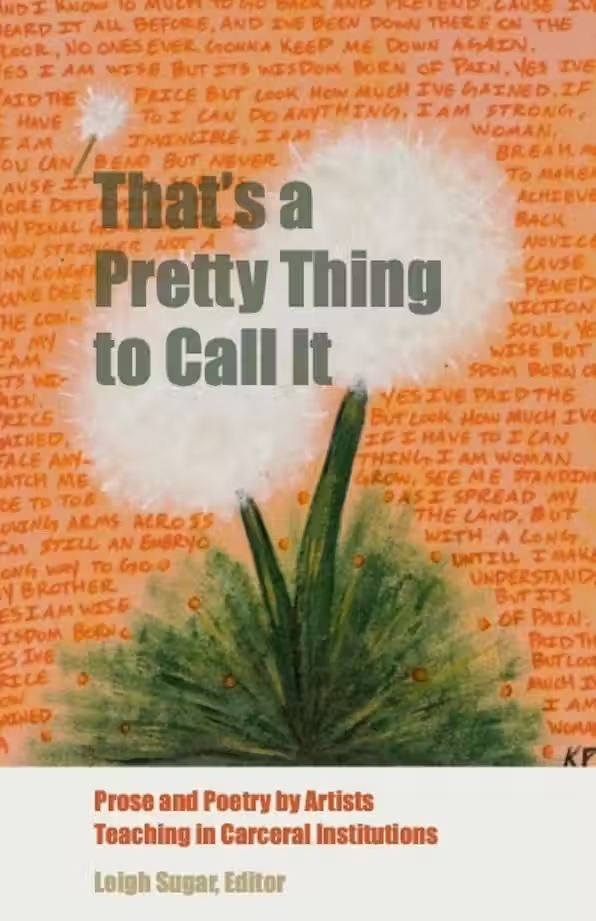
Cid Galicia Reviews “That’s a Pretty Thing to Call It” Edited by Leigh Sugar

“That’s a Pretty Thing to Call It” Prose and Poetry by Artists Teaching in Carceral Institutions

Review by Cid Galicia

Edited by Leigh Sugar
Published by: New Village Press
October 2023
IBSN: 978-1-61332-211-6

“In a real sense, all life is interrelated. All men are caught in an inescapable network of mutuality, tied in a single garment of destiny. Whatever affects one directly, affects all indirectly. I can never be what I ought to be until you are what you ought to be, and you can never be what you ought to be until I am what I ought to be…This is the inter-related structure of reality.”

-Martin Luther King
Letters From Birmingham Jail

To read Leigh Sugar’s collection of writing, in That’s a Pretty Thing to Call It, is like visiting a prison, looking through the bars, and seeing – perhaps a villainized version of yourself. How is it that when you stop and stare at the person behind bars that you both know and don’t know them? You love them, and are scared of them; You want to save them, help them, or at least listen to them. And in the end decide that the best and most empathetic thing to do is to offer connections and resources with which they can develop their voice and share it by way of publication, with hope that it will lead to positive change in the “justice system.”

This is a collection of writing by artists who have taught creative arts to people who are incarcerated or otherwise involved in the criminal legal system. Contributions were selected from submissions responding to a national call, as well as from targeted outreach to specific individuals involved in the prison arts community. I accepted poetry and prose, fiction and nonfiction. This project is unique in its poly-vocality: it gathers accounts from artists from across the country (and one international submission) working across different mediums, demonstrating the range of experiences one can have when entering these institutions.

Justice System…what a strange and sad term. One of the first thoughts in my head was how would someone go about trying to design and manifest such a potentially treacherous literary task – given the current state of the relationship between citizens and law enforcement. And even if you were able to – how would you manage to gather allies and not offend both the people whose voices you are trying to help broadcast – as well as those who fund, lead, staff, and work to keep them contained? In an interview with New York University she was asked, and addressed those thoughts and struggles openly and honestly:

I was nervous about how and where to position this writing
given that I didn’t want to speak for incarcerated artists or
co-opt the conversation. So, I realized I couldn’t be alone in
these thoughts and started reaching out to others. I soon had enough material to envision a larger collection, and the project has grown over the years through my own professional development to take on a decidedly more political stance.

As an educator in New Orleans, I know that the school-to-prison pipeline is an issue that has been “officially” pushed toward public awareness since 2005. I have deep respect for Sugar’s drive and persistence to push this collection into the present world. How do you best build opportunity, without the reflex to save? It is good that some have helped pave the path for such an undertaking.. Two years ago my MFA mentor Kate Gale, Publisher of Red Hen Press, assigned me to read and digest C. D. Wright’s One Big Self, where she laid witness to hard times in Louisiana Prisons.

Not to idealize, not to judge, not to exonerate, not to
aestheticize immeasurable levels of pain. Not to
demonize, not anathematize. What I wanted was to
unequivocally lay out the real feel of hard time.

-C.D. Wright

Sugar immediately begins to tackle, and address, the difficulty of the lexicon used when discussing the prison setting: The landscape of “hard time” is commonly represented through data. How most information is hidden from the greater population at large, and that which isn’t is geared for the receivers to see inmates/prisoners as dehumanized others. There are nearly two million people jailed in the United States, and this a greatly reduced number in the aftermath of covid. When taking into consideration parole, probation, and other alternative avenues– the real numeric data is closer to six million. The real truth is that the US incarcerates more of its people per capita than any other country in the world.

When asked the why, the reason, and the purpose for this collection–Sugar spoke on the literary community truth that should bother us all, and push us to engage in the power of poly-vocality for change: privilege and accessibility in the arts for marginalized communities.

This book is for non-incarcerated students learning about arts in prison, practitioners looking to share their skills and knowledge with incarcerated students, people concerned with questions surrounding access and privilege in the arts, incarcerated artists interested in the experience of those who enter the facilities to teach, and anybody curious to encounter the prison industrial complex from a human/creative, rather than policy/statistical, perspective.

The collection is divided into three sections: Prose, Hybrid, and Poetry. Let’s walk the prison halls and walls in this collection together, as I offer an observation of what you will encounter should you choose to fully complete the journey on your own.

Prose and Con(s)victs: To Indite or Indict, that is the question.

The prose section opens with Phil Christman’s piece, On Diction and Disprivilege: How an obscure verb changed the ways I edit prisoner’s writing. Christman is an editor for The Sky is On Fire After All: The Michigan Review of Prisoner Creative Writing Volume Six. He was editing Benjamin Cloud’s poem Prison Letters, which you can find on page 172 of Sugar’s collection, specifically the line: Pen meets paper the correspondence indited.

Indited is a transitive verb from the Old French endtier which means to put into words, to compose, or to put into writing. Cloud was right, and Christman found himself wrong. I encourage you to read this piece as he walks you through his inner turmoil of battling himself, his copyeditor/wife, and his typesetter/printer in order to remain true to the writer.

Our society’s collective unwillingness to imagine that such people (intelligent and well-spoken inmates) exist creates an atmosphere in which, even if I believe Benjamin Cloud meant to write “indite,” I’m still tempted to foist an unnecessary and absurd edit on the poem, simply because I don’t think some of his readers will be able to read the word without assuming it’s an error, one ultimately attributable to him, a man in prison, a black man – a man who hardly needs more strangers attributing errors to him. I find myself tempted to butcher his copy for his own protection! Ultimately, of course, I didn’t do so. I didn’t do so because it would be a horrible violation of my role as editor and his role as writer.

Those with privilege often have the instinct to save, correct, or override the action – and in this case the words of those without privilege. Sugar wrestled with this, as did Christman here, as do many others in this collection, and as do I. This collection of growth-oriented people, like those just mentioned, sharing their experiences and actions in contending with this marginalized group of our writing community, should push us to check ourselves to do the same – and to take action on it.

Hybridization Breakouts Come in Threes

Deep in the Hybrid Section of the collection, there is an interview of incarcerated writers selection titled: On Why “Prison Writer” is a Limited Label: What Incarcerated Writers Want the Literary Community to Understand. The stigma the prison writing community finds itself being constantly vetted by is as follows…

On the flip side, nearly every serious writer in prison I’ve encountered grows a similar disdain for, or at least frustration with, the label prison writer – one that slaps on a special qualifier of romanced danger and warped intrigue, invites immediate background checks, sets up expectations of particular content, and potentially turns off an entire readership.

Incarcerated writer Elizabeth Hayes agrees stating:

Every time a prisoner submits their writing into the public sphere they are subjecting themselves to an audience who can easily look them up and be told a prosecutor’s version of a story (true or untrue) about their conviction. This is in juxtaposition to all a prisoner desires: To put the past behind them; To lay low and quietly merge back into society; To reconnect with those they love in fresh circumstances. . . . While all artists/writers question the value of their work and wonder who is viewing it and how it is being perceived, a prisoner who is an artist or who writes always carries the added burden of having to apologize for their past.

In the early 2020s Pen America launched The Breakout Movement: Works of Justice.

This was to become an online series featuring writers and writing connected to the Pen America Prison and Justice Writing Program. The partnership aimed to dig into the relationship between writing and incarceration, and presented challenging conversations about criminal justice in the United States.

In the piece three questions are asked of the incarcerated writers:

  1. What do you want us to know about the experience of being a writer in prison? Or being a writer outside of prison (the label, the stigma, the space)? Or both!
  2. What are your hopes for how your work is received by the literary community on the outside?
  3. In what ways can you envision a lasting connection with the literary community outside the walls? From your perspective, what can we do to be more inclusive, or to help shift the narrative?

Here is one response to the first question by Zeke Caligiuri:

The story of incarceration is not a singular one. Just as the story of marginalization or the dynamics of power do not follow a singular linear moral pathway throughout our history. That is why it is important to broaden the spectrum of voices being held in the great captivity business. Whether free or encaged, we all live with some kind of stigma – that’s the nature of making decisions you can’t take back. We have to temper our own regret with our belief that our work matters at some deeply philosophical or social level, that cannot be represented by anybody else. So, as writers, we are conscientious that a sense of self-value can only be created personally. If we are looking to be redeemed at some greater social level with our work, I’d say that is an undue expectation for our art. We only get short windows of time on this earth to be and create, wasting it because we want other people to love or like, or forgive us is a lot of pressure to put on our art.

Prison Poetry Blues

“On Blueness” by Joshua Bennett appears in the poetry section of the collection. Here is the opening section of the piece.

On Blueness

which is neither misery
nor melancholy per se,
but the way anything buried
aspires. How blackness becomes
a bladed pendulum swaying between
am I not a man & a brother
& meat. How it dips
into the position
of the unthought,
then out. Trust me.
Foucault isn’t
helpful here. I am after
what comes when the law leaves
a dream gutted. The space
between a plea & please.

Bennet has become one of the most powerful emerging voices in contemporary poetry. The Sobbing School, his opening debut in 2014 and winner of the 2015 National Poetry Series Award was born out of state violence against black lives. This piece and many others in this collection force the question: What comes when the law leaves a dream gutted?

This collection is a brave and bold task of shining a light on the prison system in this country, the voices contained therein, and the allies to those voices who would broadcast the idea that their lives and voices hold value and should be heard. This is no minor or easy scripted task. Sugar, her collected writers, and their collected voices however are strong steps in the direction of placing these truths on the pens and papers of us all.


Leigh (she/her) is a writer, teacher, and, most importantly, learner. Her debut poetry collection, FREELAND, is forthcoming from Alice James Books in 2025, and she created and edited That’s a Pretty Thing to Call It: Prose and poetry by artists teaching in carceral settings (New Village Press, 2023). Her work appears in POETRY, jubilat, Split this Rock, and more. She teaches poetry workshops through various organizations including Poetry Foundation, Tupelo Press, Justice Arts Coalition, etc. She co-facilitates (with Nila Narain) Access Oriented Lit, a reading series by and for disabled poets. She also works for Commonplace, Rachel Zucker’s poetry podcast.

That’s a Pretty Thing to Call It is available from NYU Press.

Categories
book review

Finding A Life of One’s Own

Finding “A Life of One’s Own“

Book by Joanna Biggs

Review by Camilia Cenek

Harper Collins Publishers
Publication: May 2023
272 pages
ISBN: 978-0063073104

On my first solo trip since having a fourth baby, after beginning a new career as a writer in midlife, I entered a corner bookshop in Alexandria, Virginia, deliciously alone. There I stumbled upon and purchased a copy of Joanna Biggs’s literary memoir A Life of One’s Own: Nine Women Writers Begin Again. The title beckoned for obvious reasons and hinted at answers to questions spinning through my overloaded maternal mind: “How to carve out space for myself as a writer as I simultaneously inhabit the roles of woman and wife and mother” had recently become the chief project of my existence.
Indeed, the imperative against and amidst existential midlife panic.

The alluring title spoke directly to my inner urgent, terrifying quest: to delineate the borders separating me from my offspring and social load-bearing. To discover how to thrive both within and outside of the walls of maternal responsibility. Who the hell am I anyway? And how can I write in all this noise?

In this, her first literary memoir Biggs lays her cards down, too. A transplanted divorcee grieving the loss of her marriage as well as the decline of her mother, Biggs found herself bewildered and deeply depressed. Her revelations chronicle the painful sloughing off of what she thought was expected of her, what she had believed would make her happy and satisfied. As she sheds an old life and gradually grows a new one, she charts what it can mean to live as a free feminist woman in the 21st century. 

Alongside her self-assessment, Biggs profiles the parallel trials of eight prolific women writers who also once groped through life and love and work. Her study insists that all three of these strands are inextricably entwined, informing everything about an author’s process and confidence. Biggs takes encouraging familiarity with her author-subjects, titling each section by the author’s first name: Mary, George, Zora, Virginia, Simone, Sylvia, Toni, Elena. (If you don’t immediately know to whom each name refers, familiarity with each is helpful but not a requirement.) In doing this, Biggs draws these foremothers closer, forces them and us readers into close proximity that exposes their (and our) vulnerabilities, fears, and failures. In insistently setting aside the canon, the literary feats, and the patriarchal surnames, Biggs arrives at each person beneath: the fully realized woman, her name, her self. 

The literary genre where A Life resides also needs a name, what I call bibliophilic critical literary memoir, a realm of writing that I discovered only recently. The term describes memoir specifically centered on love for and experience of a particular book(s) or author(s) and explored through an informed critical lens. The previous title I encountered in this genre was Rebecca Mead’s My Life in Middlemarch which, I discovered on Goodreads, and inspired intense debate about the nature of the as-yet (to my knowledge) unnamed genre. For instance, the book was downgraded by some readers as not adhering to its own proposed formula: it had Middlemarch, it had Eliot, but the author’s life that the title promised it had not. Although by my accounting Mead admirably disclosed interweaving stories of her youth, parents, graduate studies, and personal awakenings, for some readers her biography was not baked into the book in sufficient proportion to the subjects of her study.

But to me, Mead’s My Life and Biggs’s A Life were more than a little successful–rather, they were indescribably influential. They cracked open a new way of reading, of seeing, of writing for me, a fellow writer-reader, a fellow feminist. Biggs’s book takes the next natural step beyond Mead’s, evolving from Mead’s case study of one colossal, perennially beloved and admired novel (George Eliot’s Middlemarch) to a longitudinal study of the biographies of a lineage of women writers, each of whom (Eliot included) birthed colossal, canon-forming, canon-breaking works in an array of literary genres and historical-political moments. Each writer, Biggs contends, stood on the shoulders of the sister-mother-writer-teacher (friend) who came before. And each surmounted (or didn’t) the obstacles of love, loss, self-doubt, lack of education, childrearing or childlessness, death, and suicidality that plagued them. Their struggles, like ours, were universal–prescriptive even–for women. Yet the particulars were utterly unique. 

Like Biggs and Mead, I too aspire to complete a particular memoir, one that I began years ago about the life and death of my mentally ill, suicidal mother and her impact on me. One might note that my premise sounds familiar–other notable titles in what I call the mother memoir genre include Daughter of the Queen of Sheba by Jacki Lyden, Motherless Daughters by Hope Edelman, and recently, the provocatively-titled I’m Glad My Mom Died by Jeannette McCurdy. Why on earth, you might ask, do we need yet another mother memoir, another recounting of the personal revelations of a daughter who strives to make sense of her mother’s illness? The answer is that my story is both universal and unique. Perennial and particular. I stand on the shoulders of the other feminist memoirists who came before, and who light path markers for me. Women writers don’t crowd each other out with exclusivity; instead, we usher the next one in. As Biggs shows me and other readers in A Life of One’s Own, charting one’s path through a feminine and feminist existence in this world is all of many things: fraught, fragmented, disappointing, unfair, bewildering, terrifying, exciting, and mundane. It does not, though, have to be lonely. We women writers and readers are in good company. 

On occasion, Biggs’s reverence for our mother-authors can seem gullible (such as when she takes at face value Toni Morrison’s claim that she would happily jettison her career if a young single mother with aspirations to perform brain surgery needed a nanny). Yet her humane, patient, painstaking perusal of each writer’s biographies, writings, notebooks, manuscripts, archives, and letters is breathtaking. In the end, and throughout, I am grateful to Biggs and her excellent project. Her landmark bibliophilic critical literary memoir offered a soul-nourishing, sisterly walk arm-in-arm through the lives and hearts of accomplished women writers and readers, including the ones who came before, herself, me, and – I hope – you, too.


“A Life of One’s Own“ is available now, from Harper Collins Publishers.

About the reviewer:

Camilia Cenek is a poet, writer, and editor. She has BA and MA degrees in English as well as a BA in Psychology. She once lived in France and in South Korea and now makes her home in Wisconsin. Her writing has appeared or is forthcoming in Madison Magazine, The Sunlight Press, and Creative Wisconsin Anthology. She is currently developing an essay collection about growing up with her mother’s mental illness. When not writing, she makes snacks and crafts with her four young children. Find her at camiliacenek.com.

Categories
book review

Liminal Souls: On Juliana Lamy’s You Were Watching from the Sand

Liminal Souls: On Juliana Lamy’s You Were Watching from the Sand
Review by Adams Adeosun

Red Hen Press
Publication: September 2023
176 pages
ISBN: 978-1636281056

Juliana Lamy’s You Were Watching from the Sand arrives with praise from Kevin Brockmeier and Laura van den Berg, two practitioners of the weird, and for good reason—her debut short story collection is, itself, weird. It’s a weirdness that announces itself right off the bat, at the beginning of the first and titular story, in a declaration that barrels past introduction, and past orientation, forcing familiarity with the protagonist and, perhaps, the reader: “Of course I remember you.” It’s a masquerade of a sentence, revealing nothing of the knowledge it claims but asking to be questioned all the same. The narrator hovers, disembodied but solid in voice. What follows then is a chant, incantatory, a loudness whose intent is to intimate and obliterate in the same breath. Consider this passage which comes halfway into the story—

You can’t remember, you don’t know, you don’t know, you don’t know because before it even started you’d left your body behind, you’d swam to the shore. You were watching it happen from the sand, some tiny Black boy with a face as blank as the rest of the universe, eyes so empty you couldn’t believe they’d ever been anything but.

—after a long evocation of the protagonist’s birth on a day when “all the branches of Exhaustion the River empty out inside their [everybody’s] stomachs,” after a lyrical detailing of secondary traumas, after the brief interpolation of a mother’s neurotic fixation on a religious apocalypse. It comes in a scene of direct trauma, the boy dissociating, vacating his body and the crime scene. He is unable to fully see himself for the duration of this story, the burden of intimation taken up by a divine witness (and architect) who he can’t not recognize when they meet in the coda which is at once a promise and a curse. In this opener, everything, including beauty and tenderness, is yolked inside with disaster and this is the mood of the collection.

Che, a secretly ajar girl, squats with Nadia on the upper floor of a bodega in “The Oldest Sensation is Anger”. Their relationship is rough-and-tumble, textured with minor provocations and unruly emotions, almost like cohabiting lovers. The latter is so legible in her desire for transcendence that she falls back down to earth each time she tries—“Bungee jumping when I swear, I bet anything, your ass couldn’t skydive.” The former is a riddle, a regenerative two truths and a lie, her life so disruptive to her Haitian town that she has been sent into exile in the United States. She has a “Simpsons suitcase,” a flimsiness in the specificity, as though she could have left it behind or could cast it aside any moment now and just go again.

Lamy’s collection is most comfortable in liminality and the instability of both geographical and metaphysical borders. No one is fully at home anywhere. They are either arriving or departing, appearing or disappearing, breaking in or escaping, running from or towards something. Sylpha from “Sylpha” is obsessed with Voyager (most likely the 1991 film about the post-disaster odyssey of a construction engineer), Kiki has to lay low in her mother’s sister’s house because she is in trouble in “Manticore,” Eli in “Eli” is kidnapped from his street and transported and transported for thirteen pages. And so on. 

By the final story, “Mermaids!”, all these instabilities have taken on a more logistical form: papers. “We both know that the government can send you back for not having papers,” the first-person narrator says and, a little later, “I wonder out loud if anybody’s ever tried to split papers before.” 

Despite or because of this, the characters carry their home, the Caribbean, within them like a vital organ, their minds tuned to the finer details of the histories and myths of their heritage. They are conduits and conductors for ancestral and spiritual practices. Take Sylpha’s explication of dreams for instance. 

Before Sylpha had any children, she’d wanted, more than anything, to train her dreams. All the Haitian women she knew had had dreams of the number of children they’d have before they existed in the world, and what kind of people they’d be, and Sylpha started to think that the dreaming was the point. The dreaming made a funnel of itself and forced real life to drip right through, forced real life, molten, to run here or there. And if she could train her dreams, she could control the pour of reality through them.

A private and quiet event is made into a communal and ritualistic spectacle. This is quite different from Jung’s and Freud’s dream theories although an alter ego saunters through “Belly” later. Rather, it harkens back to the arcane art of indigenous black cultures whose dream practices proceed against psychology’s run of play, the dreamer inducing the dream, coaxing something tangible out of it. In “Sylpha,” it is specifically “a Haitian thing.” 

Sylpha dreams up twins and gets, instead, a single beautiful child with a full head of hair. One auspicious phenomenon is replaced with a different one as though a token of compensation. A successful birth is, of course, cause for celebration, and yet there is despair. The fulfillment of her wish is truncated, maybe merely deferred, and in this is contained an alienation from all the Haitian women she knew. The inverse is the case in “Manticore.” Two adult sisters offset from their origin, desperate to figure out a daughter who may be possessed by godhood, pool their knowledge together to conjure their grandfather’s ghost using the vodou religion they inherited from him. It is a moment of preternatural connection between the living and the living, then the living and the ascended:

We kneel in close to each other, gathered together like fingers in a fist. I turn to my Grandpa’s picture, and I pray truths too ugly for Elijah’s god. The first? That when Kiki crashed into Arley outside of that D&B, ruptured him, a part of me wishes that I could have watched.

There’s something insistently inflammable about the bodies in You Were Watching from the Sand. They are fragile and often in danger; their identities are fluid or interchangeable with other peoples’ depending on the beholder’s desires; they are dead or incarnations of death. Their souls, however, are sturdy and ‘wayward’ in historian and writer Saidiya Hartman’s broader sense of the word: “To claim the right to opacity. To strike, to riot, to refuse. To love what is not loved. To be lost to the world.” 

Not unlike Hartman in her ethnography, Lamy fills her prose up with the world. She hyphenates traditions and genres. She stacks up impressions and sensations to the point of almost synesthesia. The collection roils with extended metaphors, a live-wire lyricism, and mythic language. Her stories appear to talk back to other writers. Is that a whiff of Carmen Maria Machado’s “The Husband Stitch” in “The Oldest Sensation is Anger”? Does “July in New Orleans” bear a note of Neil Gaiman’s American Gods? As earlier mentioned, Freud’s psychology manifests androgynously in “belly,” incandescent like the book they come in.


“You Were Watching from the Sand” is available now, from Red Hen Press.

About the reviewer:

Adams Adeosun is a graduate of the Iowa Writers’ Workshop and a 2023 MacDowell fellow.

Categories
book review

Striving for Better in Jared Harel’s Let Our Bodies Change the Subject, Review by Emily Hockaday

Striving for Better in Jared Harel’s Let Our Bodies Change the Subject

Review by Emily Hockaday

University of Nebraska Press
Publication: September 2023
80 pages
ISBN: 978-1496237293

The opening poem to Harél’s Let Our Bodies Change the Subject prepares the reader for what is to come—a meditation on mortality, the passing of the baton, generational knowledge, and existence itself. And somehow Harél faces these existential questions head-on, with care and grace. He casually introduces us to the “Sad Rollercoaster” the speaker’s daughter discovers—and which we all reckon with: 

That night and the one after,
my daughter dreams of bones—how they lift
out of her skin and try on her dresses. So silly! she laughs,

 until later, seeing the massive skeleton of a retired rollercoaster at Coney Island: 

she sees a giant wooden spine,
this brownish-red maze traced in decay. She calls it
Sad Rollercoaster, then begs to be taken home.

After my family’s corgi died when my daughter was four, she asked, “Is Cordie a pile of bones?” I didn’t know what to tell her about death or about what happens to a body once it is no longer useful to the life that inhabited it. She had seen piles of bones outside on lawns in our Queens neighborhood—decorations for Halloween. One plastic skull was left out in a flowerbed all four seasons. As a parent, and an atheist, I wanted to do as little harm as possible to this young psyche that was—somehow!—in my care. I don’t remember whether I skirted the issue or if I was gentle and direct. But I did crawl into her toddler bed, our skin touching, arms open. Any of us confronting these difficult subjects either internally or with a child or parent will feel communion with this beautiful book, with Harél’s yearning to Let Our Bodies Change the Subject.

It was the bones in “Sad Rollercoaster” that stirred up this memory of my daughter’s experience, but the collection as a whole examines what the questions of children—or our inner child—reveal within an adult. How we cobble together facts and comfort and whatever philosophy we have internalized, or wish to, to answer these quintessentially human mysteries. 

But it is not just the looming question of mortality that Let Our Bodies Change the Subject raises. That would be too neat for a poet like Harél, whose nuance and ability to weave the casual everyday details of life into larger more universal experiences is how he gets his hooks into the meat of us. This collection is as much about being parented as it is about parenting. The shockwaves and ripples that move through generations. This collection examines what it is to parent. How do we teach lessons we still haven’t learned? How do we learn them? How do we reconcile the choices that were made in our own rearing? Are we doing it right? And the few poems sprinkled throughout questioning religion and god reinforce these themes—another search for something elusive that doesn’t have exact answers.

One thread throughout this collection that really spoke to me was the sense of unease that lingers in difficult decisions. The speaker appears insecure in their happiness and good fortune—and in parenting. This is something we can all relate to. We first see this in “The Sweet Spot” on page five—a brief and lovely poem that gives voice to the universal insecurities that grow like weeds inside all of us. The speaker proclaims, “. . . we have hit/ our sweet spot, the best it’s gonna get . . .” But don’t believe it, reader. I refuse to. Later on in “Plastic Butterflies,” we are told:

. . .Nowadays
I can’t tell who I’m meant to help,
or how to help, or if anything really helps
anymore, although I guess that’s me

Set in contrast to his past, childless self, confident in youth, our speaker questions themself. This niggling insecurity weaves through the collection as a whole, making the speaker and their life relatable—and likable. In “Too Soon in San Antonio,” this echoing worry is stark: there are things the speaker should know, that maybe others do, but they do not. The vibrating insecurity behind the heart of this collection is brought to the fore: Are we doing this right? And miraculously, there is the acknowledgment that we can only do our best with the information we have. “The Other Side of Desire” gives us a slightly different take on this. The speaker is disenchanted and restless with the life he has found himself in. But even as he longs for a break in routine, we see the tenderness with which he loves his life. The care put into parenting and being a spouse. This poem is perhaps the one most full of love and contentment, despite the confession—that sliver of desire to escape that all of us feel and at times may even nurture. 

We get our most interesting insights when we see the speaker through his children—their voices, their questions, the way he second-guesses himself, like all parents do. How daunting to find oneself a fallible parent with people who need you to be invincible and all-knowing. In “The Perimeter,” we hear our own inner thoughts in the voices of the speaker’s children—Harél skillfully draws parallels between generations:

My excitement hurts, my daughter sulks
at Columcille Megalith Park, where stones stack
on stones upon a great big stone circling
the sun. It’s mid-July, muggy, and my excitement 
hurts too, though somewhere along the line
I lost the right to say so. Or the nerve. . . .

It is exactly when the speaker has the nerve to be his most frank that we see his thoughtfulness, his tender application of parenthood and even personhood. And this poem is a shining example of just that. In “A Moving Grove,” Harél writes: 

. . .  All year
I’ve been tring to say something
real, or at least really clever, which
might be my undoing. The kids
want answers about death and God
and if the Muppets are alive and why
is it sunny and when can they stop
hiding in closets at school? . . .

We know that the speaker, too, wants answers. About death and God and the relentless queries and how to know that our choices matter. I know how it feels for time to stop while formulating the answers to the unknowable. The weight of the words as they are parsed. And the poet gives us both the frozen moments of indecision and also the rushing of time, as the rug is pulled out from under us. In another poem, the speaker watches his child moving away from him. In “Overnight” we see a daughter racing “unencumbered/ toward her friends”,  while the speaker reminisces:

Just yesterday she clung
to the nape of your t-shirt,
begging to stay.
Just yesterday
she was yours, and you,
you gave her away. 

Harél excels at depicting this motion—the inexorable movement of generations spinning forward as they only can.

In Harél’s examination of parenting and replacement, another refrain rises to the surface in this collection. The speaker considers his own childhood, acknowledging the replacement of one generation with the next, tying poems together, as parent and child, thematically. In “Beer Run,” the speaker is a child and is pulled from an unsafe vehicle at the last minute. The fear and anxiety of parenting—that has been so precisely described from the speaker’s perspective as a parent—now from his own parent’s perspective, is only something of which he is aware in hindsight:

“. . . How could I have guessed
why my father was sprinting, screaming after us
down the middle of the street, or why he wouldn’t stop
shaking as he ripped me from the truck?”

All of us who make it to adulthood have had to face our parents’ humanity. The full depth of it. Harél is generous in his poems—all of these parents are doing their best. Even when they aren’t perfect. We see the reckoning of the passing torch of parenthood in “Kin” and “Behind the Painted Guardrail,” but in other poems the poet goes even further, considering what is passed down through multiple generations. Jared and his speaker recognize that no one parents alone—behind all of us are our ancestors and their lessons, those we are trying to unlearn, mitigate, or continue. In “Cordoba,” we learn about the speaker’s grandfather, and the poem allows that we may all end up like the titular Cordoba— 

. . . moved 
to my parents yard
where it sat rotting
on deflated tires: a relic.
An eyesore. A pit of wasps
writhed under its hood.

The speaker doesn’t preclude himself as the possible someone who hands down what ought not be handed down. In perhaps the most musical poem in the book, “Ruins,” Harél deftly delivers a rhythmic poem in short-lined tercets about trying to teach a son about safety. He concludes:

—if I confess
terror casts me as a father
to son, like a shadow
that outruns me,
am I well overrun?

Ultimately Let Our Bodies Change the Subject teaches us that parenting is not done alone—even when it is full of what feels like recklessly choosing, in the moment, what we believe to be correct. In these choices are the experiences of parents, grandparents, and echoes of ancestors, just as the speaker tells their daughter in “Birthday” of aging and the self when “she didn’t want . . .  to leave herself behind”:

[I] said, You take it
all with you, you bring all
your selves with you
into the future. I don’t know
what I believe, but I think
she believed me.  

Looking back at the second poem in the collection (“All I’ve Ever Wanted”) we read: “what humbling work/it is to haul kids toward thoughtful—the kind/ in humankind.” And later in this poem the speaker says: 

. . . My point about discovery
has escaped me by now, though I know
the old chorus for thwarted desire. My cereal
will be dry. Coffee taken black. I will try
against hope to be better than myself, which is all
I’ve ever wanted and everything I need.

By the end of this collection, the point has not escaped us, the reader. And it is clear that the speaker is striving for “better,” and from this reader’s perspective, succeeding. These poems speak to the connections between family members and generations, the powerful and versatile force that is love, and being exactly where you are, even as the ground shifts beneath you.


Let our Bodies Change the Subject, available September 2023 from University of Nebraska Press.

About the reviewer:

Emily Hockaday’s second collection, In a Body, is forthcoming with Harbor Editions October 2023. Her first full-length, Naming the Ghost, debuted with Cornerstone Press in September 2022. She is the author of six poetry chapbooks, most recently Beach Vocabulary out from Red Bird Chaps & Name this Body from Thrash Press. Emily writes about ecology, parenthood, chronic illness, grief, and the urban environment. You can find Emily on the web at www.emilyhockaday.com or @E_Hockaday.

Categories
book review

In Everything I See Your Hand by Naira Kuzmich Review by Carrel Barber

In Everything I See Your Hand

Review by Carrel Barber

University of New Orleans Press
Publication: June 2022
192 pages
ISBN: 1608012379

The Predestined Fiction of Naira Kuzmich 

There is an Armenian belief known as jagadakir which translates literally to “the writing on the forehead” and it is the idea that one’s destiny is predetermined and therefore for the world to see. This superstition lives in the protagonists of Naira Kuzmich’s short story collection titled In Everything I See Your Hand. They are Armenian-Americans who struggle with dispossession, domesticity, and generational differences. They wonder about exile and the difference between leaving the motherland vs. leaving one’s mother while chasing grander things in far away places. 

A better life in America, education at faraway universities, and even love in marriages to foreigners. These are people who struggle with the belief that the story of their lives have already been written and the only possible escape from that destiny is through death or departure. Kuzmich writes with power and precision that influences both her characters and her readers to see the beauty of this fleeting life’s pain and forces one to reckon that they must go on despite the hurt. 

All ten of the stories in this beautiful, haunting collection take place in the “Little Armenia” neighborhood in East Hollywood, California. These are immigrants and the children of those immigrants who fled to the United States after the collapse of the Soviet Union in the 90s. The stories are all influenced by Kuzmich’s own experiences and she uses this honesty to portray deep truths about Armenia, America, and what it means to be an Armenian-American. 

Several stories live along the blended borders of the motherland and the new land of America. One in particular, “Woman Amid Ruins” leaves a deep impression on the reader. It tells the story of Zara, the lone child survivor of the 1988 Armenian earthquake in the town that was its epicenter, Spitak. While the story is literally taking place in the bedroom of Zara and her new husband, it bounces between time and place with fluidity. She is processing her trauma and her life and how her destiny has led her to America. Having been the lone child survivor in town left Zara with a feeling of both that she was special, and that she had somehow cheated her destiny. This leaves her searching for answers that led her across Armenia, in the arms of different men, and finally to America. Zara’s desire for answers for her self-fulfillment culminates in an interaction with a former lover of hers, a painter. Zara asks, “Can you paint my face,” because “what she wanted to see was her forehead, just to see what was written there, once and for all” (Kuzmich 35). This is a woman who lost her connection to her family and her ancestry and is yearning for cultural identity and assurance. 

While some characters are searching for the culture and heritage, others are tired of the constant reminders of the tragedies that have followed their people. The Soviets. The earthquakes. The genocide. It never seems to end and the protagonist of the final story,  “Transculturation, or: An Address to My American Lover”, is tired of it. While her lover is trying to learn as much about her culture as possible, from learning facts such as the number of people who died in the Spitak Earthquake (over 60,000) to how to say “I love you”. This desire that he has wears on the protagonist despite the good natured intention behind it. Ultimately though, she doesn’t appreciate it. She knows 

“that there is nothing more to my people than tragedy. That this is what you see every time you look at me. That this is what is written clearly on my forehead. Don’t you dare go giving me another reminder, lover. I have enough.”

(Kuzmich 176) 

The deep truths that this story and it’s protagonist talk about range from cultural touchstones such as the duduk or famous Armenians. She treats everything as it is, most powerfully the blank page that represents her thoughts on the Genocide. The white space a gut punch that Armenians must feel whenever it becomes the topic of conversation. This protagonist and her forehead represent more than just her personal destiny, but rather the history of her people. While it is bold for an author to speak for an entire culture, Kuzmich brings us outsiders into the fold of the Armenian-American world in which she was raised. 

Jagadakir plays a large role in this collection, as the word forehead is found 14 times across the ten stories. One story in which it is not mentioned, is perhaps the most eerie and predestined of the bunch. This story in the opener, titled “Beginning Armenian”, follows a young woman who has been diagnosed with breast cancer in her twenties. Kuzmich herself was diagnosed with lung cancer in her twenties and lost her battle at 29. Heavy is the head that wears the crown bearing representation of their culture, and Kuzmich wore that crown above her destined forehead with pride and a sharp eye. 

Kuzmich was searching for more meaning in her work and felt it is what counted above all else according to her mentor and friend Josie Sibara, who wrote the introduction to the collection. This meaning centered on the idea of continuing on the beautiful tragic journey that is life despite all of the roadblocks and signs telling you to give up. A lesson that we all need to be reminded of. Kuzmich made sure her characters never lost hope and through the page it is palpable that she never did either. 


In Everything I See Your Hand is available now from University of New Orleans Press.

About the reviewer:

Carrel Barber is an MFA student at Florida State University where his focus is in fiction. His work has appeared in Big Bend Literary Magazine and Poetica. He lives in Tallahassee with his wife and occasionally obedient dogs.

Categories
book review

Curing Season by Kristine Langley Mahler, Review by Ashley Espinoza

Curing Season: A Look at a Lyrical Memoir

Review by Ashley Espinoza

Curing Season
by Kristine Langley Mahler
West Virginia University Press
Publication: October 2022
Paperback, 192 pages
ISBN: 978-1-952271-65-6

Curing Season: A Look at a Lyrical Memoir

Curing Season is a lyrical essay, a segmented essay, and a hermit crab essay, all in one book. It is written in the container of a book but explores the various forms given to creative nonfiction. With essays like “Shadow Box” which is written in squares and rectangles to be contained in a shadow box, “Mädchenfänger” a list essay, several segmented essays, and a photo essay, this collection is not a straightforward narrative.

The subtitle of Curing Season is “Artifacts” which accurately describes this essay collection. Kristine Langley Mahler has collected artifacts from her life and presented them in a way that reads like a collection of her life. Each essay is its own artifact as they reveal something about the author in a way she is trying to reveal her past self to her current self. The subtitle Artifacts refers to the essay and artifacts Langley writes about while the title Curing Season is a reference to the tobacco curing season in Pitt County. This book is a preservation of her time in Pitt County, just as curing tobacco is a preservation of the plant. 

I love creative nonfiction in hybrid and lyrical forms. Curing Season hits the right intersection of writing with brevity. I know what Langley Mahler’s life was like in these short experimental essays, without the need for long descriptive scenes. This book allows the reader to pause and reflect on their own lives. I found myself relating to my own adolescence and the challenges it brings. The short chapters pull the reader through this coming-of-age memoir.

Langley Mahler is obsessed with place. So much so that much of her book is exploring what a specific place means to her and to her adolescence. She opens up her segmented essay “Club Pines,” with a section titled ‘My House,” where she reveals her family had moved to an upper-middle-class suburban area in North Carolina from Oregon. Though her childhood was spent in Oregon she felt displaced as an adolescent in Club Pines.  The segmented essay moves on to discuss each one of her friend’s homes and what each one means to her. In visiting each home Mahler reveals her discomfort in being in a new town. In Michelle’s house, Mahler states that she is never invited back once Michelle realizes that Mahler is being bused to an urban school in an effort to desegregate. In other friend’s homes, she visits families that don’t eat dinner together, kids that don’t have rules, and homes that are filled with tobacco smoke. When faced with homes Mahler doesn’t feel comfortable in, she calls her mother to get her. On another occasion when her friend Heather curses in front of adults she leaves. Mahler has a specific idea in her mind of how her friends and their families should behave and if they don’t act according to her ideas about family she doesn’t stick around. Each section signifies how badly Mahler wants to fit in with the girls in her school, but she doesn’t know how, and her experiences don’t match up with her expectations.

Kristine Langley Mahler continues to explore her obsession with place and turns it into art on the page. Her essay, “A Pit is Removed, A Hollow Remains” is a clever title derived from the author living in Pitt County, North Carolina. Mahler, who is the pit in this essay, leaves Pitt County and as an adult obsesses over living there. It’s a place of her life that is hollow because she keeps coming back to those years to make sense of them. She also tries to make sense of a girl that was her friend but has since passed away. 

She writes “I have not physically been to Pitt County in fifteen years. It doesn’t matter. I have been there fifteen hundred times in my mind.”

She takes her own personal obsession of tracking Pitt County down to googling what people’s homes look like and she turns it into a personal narrative. The author is very self-aware that her obsessive behavior is the fuel behind her work. The four years of her youth living in Pitt County informed her whole life. It took over her adolescence in being displaced and it’s taking over her adulthood as she tries to unmask this location and tries to find the root of why she can’t let it go.

“I arrowed through Google Maps on Street View; I narrowed to my neighborhood on Airbnb and broke into houses, wandering through rooms I’d been in and houses I’d biked past.” 

It almost seems as if Langley Mahler has gone too far in her quest to search her past. That thought brings great tension and gives the reader a moment to consider their own past and how they handle researching who they used to be. Not everyone will go as far as tracking down specific homes and looking at photos on Airbnb. This adds to the level of obsession Langley Mahler has and it adds to her strong desire to make sense of a confusing time. It’s as if she has no choice to but go to extremes in order to find what she’s looking for. This plays into her as a writer and an artist. She will go to great lengths in her self-discovery. 

Curing Season pushes boundaries on what a memoir and an essay collection can look like. There is no one specific way to write an essay or an essay collection and Langley Mahler lets her exploration of form provide a new way to explore the self.


The Curing Season is available now from West Virginia University Press.

About the Reviewer:

Ashley is an MFA graduate of the University of Nebraska-Omaha with a focus on creative nonfiction. Her work has been published in The Magic of Memoir: Inspiration for the Writing Journey and in (Her)oics: Women’s Lived Experiences During the Coronavirus Pandemic, as well as in the Place Where You Live column for Orion Magazine. She is currently writing a memoir of the aftermath of her (step)father’s paralysis while her teenage mother tries to keep custody of her and graduate high school.